
How Bethesda Mortgage Brokers Handle Self-Employed Loans Differently Than Banks
Bethesda mortgage brokers handle self-employed loan applications by utilizing alternative qualification methods that banks typically reject. While traditional banks rely strictly on W-2 income and rigid debt-to-income ratios, independent brokers in Bethesda, Maryland, leverage bank statement loans and Schedule C add-backs to accurately reflect a self-employed borrower's true cash flow. This approach allows self-employed professionals to qualify for larger loan amounts that align with their actual financial reality rather than their tax-optimized returns.
The Limitations of Traditional Bank Underwriting
Traditional banks operate under strict, standardized underwriting guidelines that often penalize self-employed borrowers. A bank's primary focus is on documented W-2 income and the net profit line on a tax return. This creates a significant barrier for self-employed individuals who maximize tax deductions to lower their taxable income. When a borrower claims substantial deductions for business expenses, the bank sees a lower net profit, which directly reduces their qualifying income for a mortgage. This rigid framework often results in lower loan limits or outright denials, even when the borrower has ample cash flow and a strong business.
Alternative Qualification Methods Used by Brokers
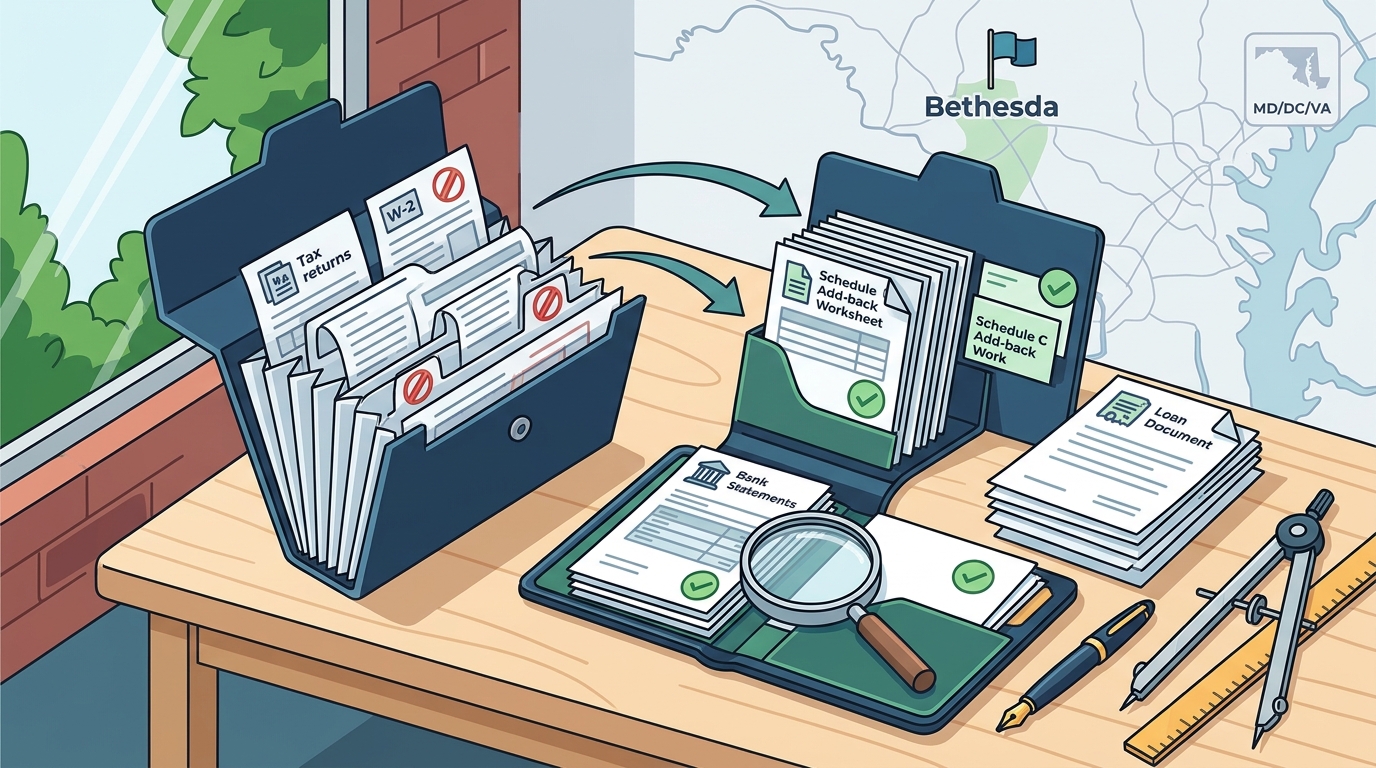
Independent mortgage brokers in Bethesda utilize alternative qualification methods that look beyond the bottom line of a tax return. One primary method is the bank statement loan, which allows lenders to underwrite based on 12 to 24 months of business bank deposits rather than tax returns. This method is particularly useful for self-employed borrowers who have not yet completed two years of tax returns or who have significant non-cash deductions. By analyzing actual cash flow, brokers can demonstrate a borrower's ability to repay the loan, bypassing the limitations of traditional tax-based underwriting.
The Power of Schedule C Add-Backs
Strategic Tax Planning for Mortgage Qualification
Choosing the Right Financing Path
Choosing the right financing path is crucial for self-employed borrowers in the Bethesda area. A mortgage broker can evaluate a borrower's specific financial situation to determine whether a traditional tax return loan, a bank statement loan, or a non-QM loan is the best fit. Each option has its own set of requirements and trade-offs, and the right choice depends on factors such as credit score, business structure, and long-term financial goals. By providing personalized guidance, brokers help self-employed borrowers navigate the complexities of mortgage qualification and secure the financing they need to achieve their homeownership goals.
Key Takeaways
- Traditional banks rely on W-2 income and net profit, which can penalize self-employed borrowers who maximize tax deductions.
- Bethesda mortgage brokers use alternative qualification methods like bank statement loans to assess true cash flow.
- Schedule C add-backs allow brokers to add back non-cash expenses, increasing a borrower's qualifying income.
- Strategic tax planning can balance tax savings with mortgage qualification, potentially unlocking more home buying power.
- Choosing the right financing path requires a personalized evaluation of a borrower's financial situation and goals.
- Working with an independent broker provides access to a wider range of lending options and more flexible underwriting guidelines.
Frequently Asked Questions
What is a bank statement loan?
A bank statement loan is a type of mortgage that allows self-employed borrowers to qualify based on their business bank deposits rather than tax returns. This method is useful for borrowers who have not yet completed two years of tax returns or who have significant non-cash deductions.
How do Schedule C add-backs work?
Schedule C add-backs involve adding back non-cash or non-recurring expenses to a borrower's net profit to determine their true qualifying income. Common add-backs include depreciation, depletion, and business use of home expenses.
Can I use a bank statement loan if I have a W-2 job?
Yes, you can use a bank statement loan if you have a W-2 job and a side business. The loan can be based on the cash flow from your side business, while your W-2 income is also considered in the underwriting process.
What is a non-QM loan?
A non-QM loan is a type of mortgage that does not conform to the guidelines set by the Federal National Mortgage Association (Fannie Mae) or the Federal Home Loan Mortgage Corporation (Freddie Mac). These loans often have more flexible underwriting requirements and can be a good option for self-employed borrowers with complex financial situations.
How much can I increase my qualifying income with add-backs?
The amount you can increase your qualifying income with add-backs depends on your specific business expenses. In some cases, add-backs can increase qualifying income by 20% to 50% or more, significantly boosting your home buying power.
Do I need to reduce my tax deductions to qualify for a mortgage?
You do not necessarily need to reduce your tax deductions, but it may be beneficial to do so. A mortgage broker can model different deduction scenarios to show the trade-off between paying more in taxes and qualifying for a larger loan.
How long does it take to get approved for a self-employed mortgage?
The approval process for a self-employed mortgage can take longer than a traditional W-2 mortgage due to the additional documentation required. However, working with an experienced broker can help streamline the process and ensure that all necessary documents are submitted correctly. Learn more: Contact Us Infinite Home.