
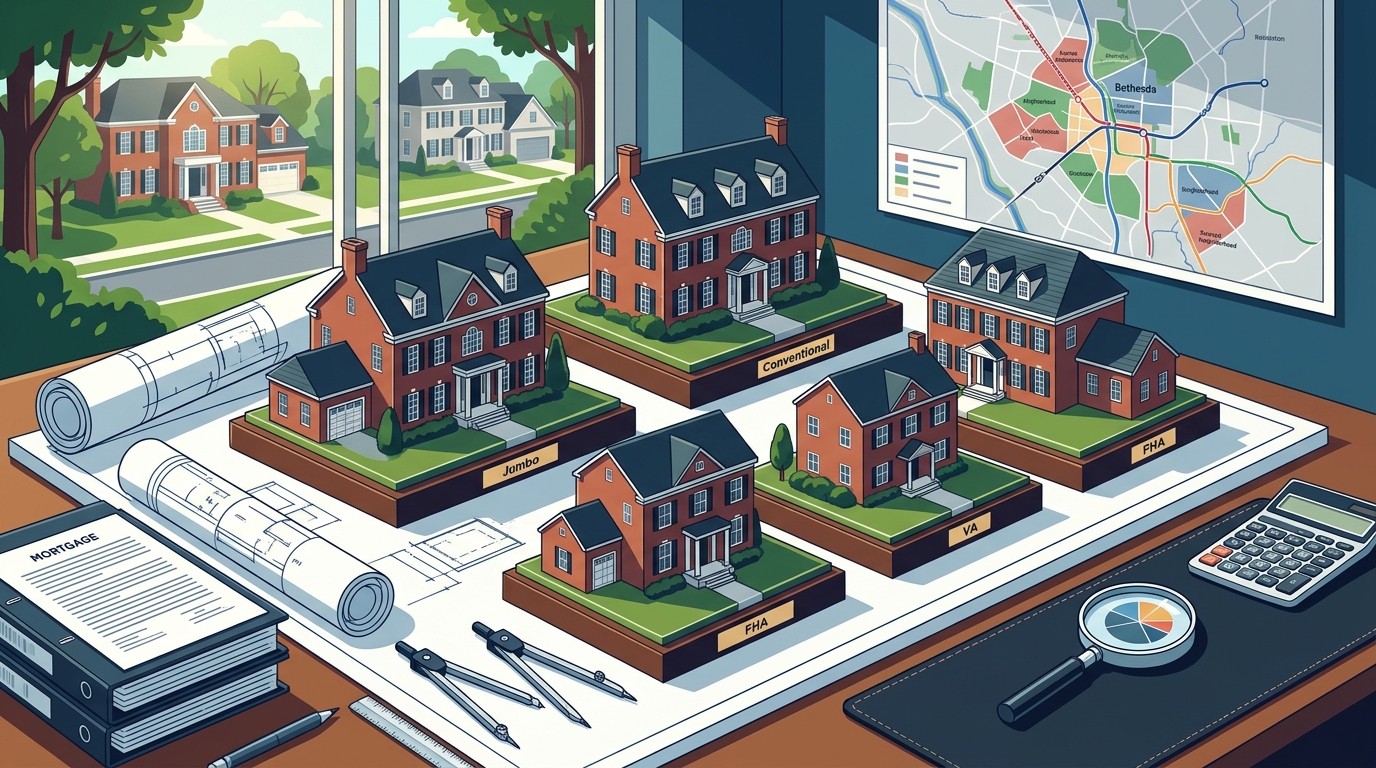
Bethesda is one of the most desirable and expensive neighborhoods in the Washington, DC metropolitan area. Homebuyers in this region often face high price points, strict qualification requirements, and complex loan options. Infinite Home Lending helps clients navigate these challenges by focusing on loan structure rather than just headline interest rates. This guide outlines the five most common mortgage types available to Bethesda residents and their primary advantages and disadvantages.
1. Conventional Financing
Best for buyers with stable income and good credit who want flexible terms.
Conventional loans are not backed by the federal government, offering borrowers a wide range of lender choices and competitive rates. In Bethesda, where home values are high, conventional loans are the most frequently used product for primary residences. The main advantage is the ability to remove Private Mortgage Insurance (PMI) once you reach 20% equity. The primary downside is that these loans typically require a higher credit score and a larger down payment compared to government-backed options.
2. FHA Loans
Ideal for first-time buyers who need a lower down payment but must plan for long-term mortgage insurance.
The Federal Housing Administration (FHA) loan is a government-backed mortgage that allows borrowers to put down as little as 3.5% of the purchase price. This is a significant benefit for buyers in Bethesda who may not have saved a large down payment. However, FHA loans come with an upfront mortgage insurance premium and an annual premium that lasts for the life of the loan if you put down less than 10%. This makes the total cost of ownership higher over time compared to conventional loans.
3. VA Loans
Exclusive to eligible veterans and service members, offering zero down payment and no monthly mortgage insurance.
The Department of Veterans Affairs (VA) loan is a powerful tool for military-affiliated buyers in the DMV area. The primary pro is that eligible borrowers can purchase a home with no down payment and no monthly mortgage insurance requirement. This significantly reduces the initial cash needed to close. The main con is that the loan is only available to those who meet specific service requirements, and there are limits on the loan amount that may require a down payment for higher-priced Bethesda properties.
4. Jumbo Loans
Necessary for high-value properties that exceed standard conforming loan limits.
A jumbo loan is a mortgage that exceeds the conforming loan limits set by the Federal Housing Finance Agency. Because Bethesda contains many luxury homes, jumbo loans are a common necessity for buyers in this specific market. The advantage is access to financing for high-end properties that standard loans cannot cover. The disadvantage is that jumbo loans often require higher credit scores, larger down payments (often 20% or more), and more rigorous income documentation, making them harder to qualify for.
5. DSCR Investor Loans
Designed for real estate investors who want to qualify based on property cash flow rather than personal income.
Debt Service Coverage Ratio (DSCR) loans are specialized products for investors purchasing rental properties in Bethesda and the surrounding area. The key benefit is that lenders evaluate the loan based on the rental income the property generates, rather than the borrower's personal income or debt-to-income ratio. This allows investors to qualify for more properties. The downside is that DSCR loans typically carry higher interest rates and require a larger down payment than owner-occupied loans.
Choosing the Right Loan for Your Goals
Selecting the right mortgage type depends on your specific financial situation and long-term plans. If you are a first-time buyer with limited savings, an FHA loan may be the most accessible entry point. If you have strong credit and a stable income, a conventional loan offers the most flexibility and lower long-term costs. For high-value properties, a jumbo loan is often the only option, while investors should consider DSCR loans to maximize their portfolio. Infinite Home Lending provides personalized guidance to help you evaluate these options and choose the structure that fits your life, not just a headline rate.
Frequently Asked Questions
What is the minimum down payment for a home in Bethesda?
The minimum down payment varies by loan type. FHA loans require a minimum of 3.5%, while conventional loans can start at 3% for some programs. Jumbo loans typically require 20% or more, and VA loans require no down payment for eligible veterans.
Can I use a VA loan to buy a home in Bethesda?
Yes, eligible veterans and active-duty service members can use VA loans to purchase homes in Bethesda. However, because Bethesda home prices are high, you may need to make a down payment if the purchase price exceeds the VA loan limit for the area.
What is the difference between PMI and MIP?
PMI (Private Mortgage Insurance) is required for conventional loans with less than 20% down and can be removed once you reach 20% equity. MIP (Mortgage Insurance Premium) is required for FHA loans and generally cannot be removed without refinancing, making it a longer-term cost.
Are jumbo loans harder to get than conventional loans?
Yes, jumbo loans are generally harder to qualify for because they are not backed by government agencies. Lenders often require higher credit scores, larger down payments, and more extensive documentation of income and assets for jumbo loans.
How does Infinite Home Lending help with loan selection?
Infinite Home Lending works with multiple lenders to structure loans that fit your specific goals. We focus on the overall loan structure, including rates, terms, and insurance costs, to ensure you make an informed decision rather than just choosing the lowest headline rate.